he Shifting Landscape of the Arcade & FEC Industry
The family entertainment industry is changing. Rising real estate costs and evolving guest expectations are pushing operators to rethink traditional arcade models.
Redemption-heavy arcades have been the standard for years, but they often require significant space, higher capital investment, and larger teams to run.
Through my experience operating several family entertainment centers (FECs) in the same market and geographic area, I started to notice patterns — and I wanted to understand them better.
When we launched ClawCADE, I saw an opportunity to put the model to the test against the more traditional redemption-heavy arcades I’d been running for years. So, I dug into my own numbers: revenue per square foot, equipment costs, staffing needs, and even guest behavior.
The findings were eye-opening.
This article shares that comparison, not to say one model is right for everyone, but to give operators a clearer view of how these two approaches can play out in the same market conditions.
Revenue Density: A Key Metric
In the arcade business, revenue per square foot is one of the most important measures of performance.
Looking at my own FECs in the same market, I compared the results of the ClawCADE model with traditional redemption-heavy arcades.
Here’s what I found:
ClawCADE model (6,000 sq ft):approximately $516 per sq ft
Typical FEC arcade (4,500 sq ft):approximately $422 per sq ft
These numbers come directly from operations I’ve run in the same geographic area and market demographics. That said, they are historical examples and not a guarantee of future performance. Results will always depend on factors like location, market conditions, and operational practices.
Equipment Costs: The ROI Perspective
Another big factor in an arcade’s success is the upfront investment in equipment.
Here’s what I’ve consistently seen in my own experience:
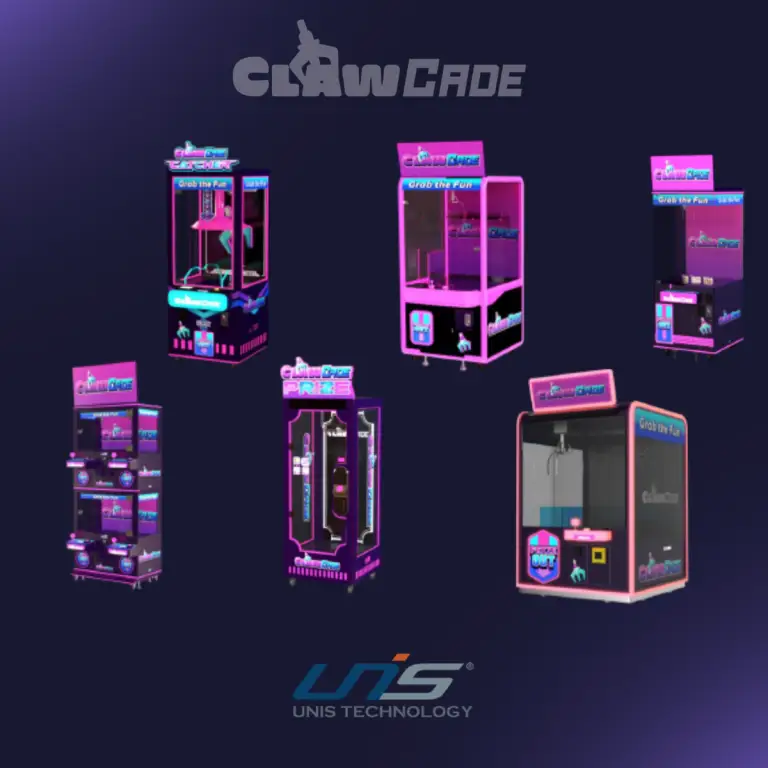
Claw machines:average about $2,900 per unit
Redemption/video games:often range between $12,000–$18,000 per unit
This difference can allow operators to deploy more machines in the same space, potentially improving ROI and flexibility. However, as always, ROI is determined by local demand, pricing, and management.
Operational Simplicity
One of the first things I noticed when shifting to the ClawCADE model was how much simpler certain aspects of day-to-day operations became:
Streamlined redemption: The trade-up prize wall helps eliminate long prize lines.
Lean staffing: A smaller team can often manage larger claw banks.
Lower maintenance: Standardized claw machines tend to be simpler and less expensive to maintain.
Every location has its own challenges, but for me, this was a noticeable shift that reduced friction and overhead.
Guest Experience: What Keeps People Playing
From running both models, I’ve seen how guest experience drives repeat visits.
With ClawCADE, players tend to appreciate:
The excitement of instant wins directly from the machine
The sense of progress through the trade-up system
A feeling of control and value in their experience
These elements often encourage guests to play longer and return more frequently — though of course, local market dynamics and execution make a difference.
Built for Growth
Another advantage I’ve experienced is flexibility.
ClawCADE can be integrated into under-utilized spaces in existing FECs or launched as a standalone arcade. Operators can start small and scale up over time.
That modular approach has been helpful in planning expansions while keeping risk in check.
Why I’m Sharing This
Having operated both traditional redemption-heavy arcades and now ClawCADE locations in the same market, I wanted to share what I’ve learned so others can make informed decisions.
This isn’t about one model being “right” for everyone. Every market, location, and operator is different. But I believe that comparing results based on real-world operations — not just theory — helps all of us in the industry move forward with more confidence.
Important Note
This article is for informational purposes only and is not an offer to sell or a solicitation of an offer to buy a franchise.
All performance figures mentioned above are based on historical results from my own FEC operations in the same geographic market. These should not be taken as a projection or guarantee of your results. Your success will depend on many factors, including location, local competition, market conditions, and your own operational practices.
Anyone considering a ClawCADE franchise should review the current Franchise Disclosure Document (FDD) and seek professional financial and legal advice before making investment decisions.
Closing Thoughts
The arcade and FEC industry is evolving, and it’s worth re-examining old assumptions. By sharing my experience and the comparisons I’ve made across my own arcades, I hope to give operators more clarity as they think about their next steps.
If you’re curious about how the ClawCADE approach might work in your market, this comparison may help you understand how it can fit into today’s industry landscape.